Basics
BTC and satoshi: how to read amounts without losing zeros
One bitcoin consists of 100 million satoshis. A conversion does not change the value of an amount, only how it is written. Using model examples, we show conversions and the difference between an amount and a fee rate.
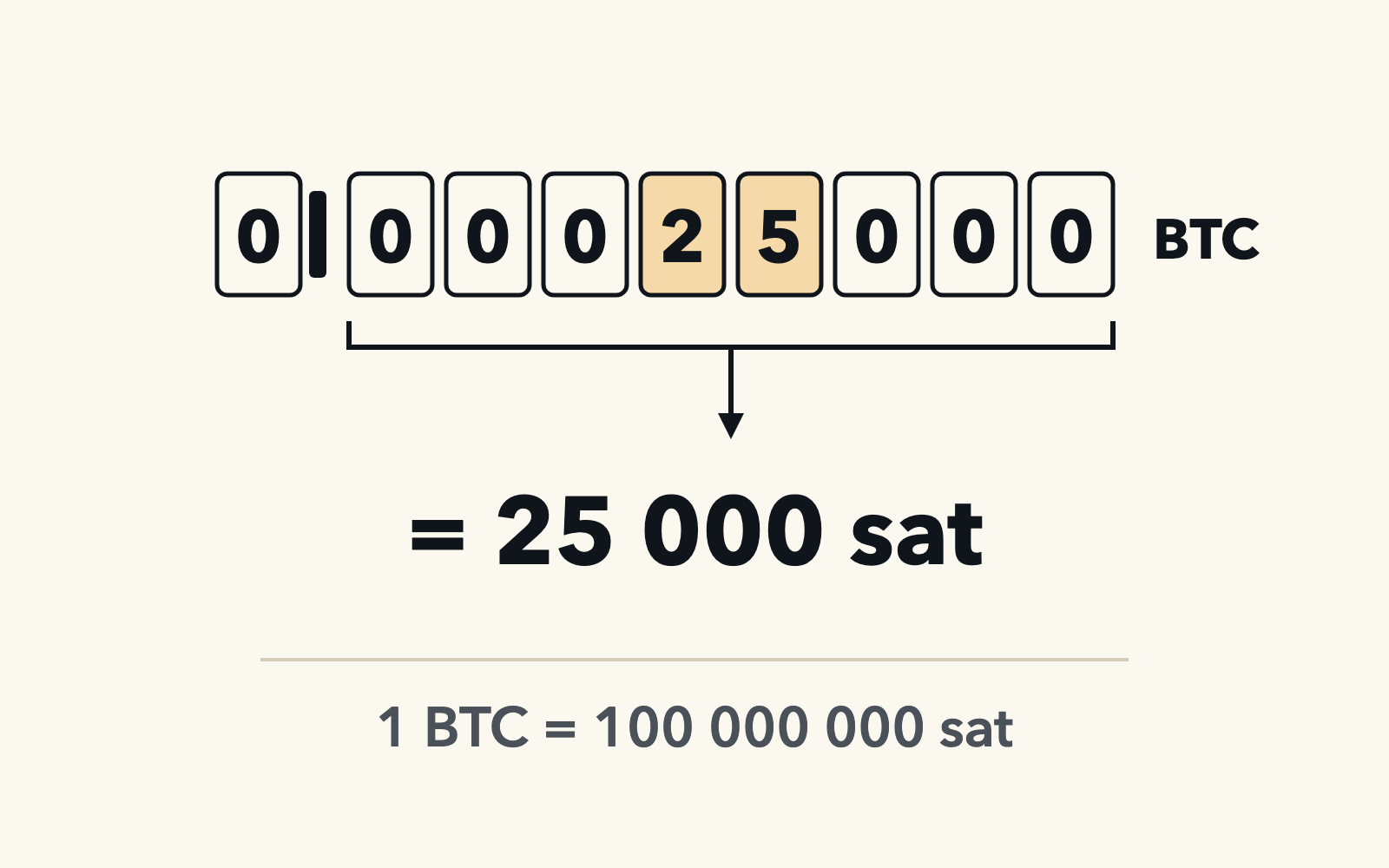
The illustration contains Czech text and has not been localised.
One app shows 0.00025000 BTC, another 25,000 sat. Both are the same amount in different units. What matters is the label after the number, not how many zeros you see.
One bitcoin, a hundred million satoshis
A satoshi (sat for short) is the unit in which Bitcoin Core, the reference software of Bitcoin, calculates amounts. There, one BTC is defined as 100,000,000 satoshis and amounts are calculated as whole numbers of satoshis, as the definition of CAmount and COIN shows. One sat therefore corresponds to 0.00000001 BTC.
Amounts recorded in the Bitcoin blockchain have at most eight decimal places in BTC, because the protocol works with whole satoshis. You can pad 0.01 BTC to 0.01000000 BTC and the quantity stays the same. Trailing zeros add nothing. A zero inserted after the decimal point before the first non-zero digit, however, changes the value.
The table is only a calculation aid. It contains no real balances, no recommended amounts to buy and no present-day prices.
| Amount in BTC | The same amount in satoshis |
|---|---|
| 1 BTC | 100,000,000 sat |
| 0.01 BTC | 1,000,000 sat |
| 0.001 BTC | 100,000 sat |
| 0.00025000 BTC | 25,000 sat |
| 0.00000001 BTC | 1 sat |
Converting in both directions
To convert from BTC to satoshis, multiply by 100,000,000. The model amount of 0.00025000 BTC thus gives 0.00025000 × 100,000,000 = 25,000 sat.
In the other direction, divide by the same number: 75,000 sat / 100,000,000 = 0.00075000 BTC, or 0.00075 BTC in shortened notation. An amount in satoshis needs no leading zeros; in this unit you are already counting whole units.
You can check the result by converting back. If 25,000 sat came out as 0.0025 BTC, converting back would give 250,000 sat, ten times the starting amount. The mistake is then in the conversion. If you are unsure, go back to the unit and the calculation instead of estimating the amount from the length of the number.
Decimal separators and other units
This English version uses the decimal point, as technical notation may also do, for example 0.00025000. That does not mean a comma and a point can be swapped freely in every form. Check which format the particular application accepts.
According to its list of units in the source code, the graphical interface of Bitcoin Core 29.0 knows mBTC and µBTC besides BTC and sat; there, µBTC is also labelled “bits”. One mBTC is a thousandth of a BTC (100,000 sat) and one µBTC a millionth of a BTC (100 sat). This applies to that particular implementation, not to how every wallet looks.
On a screenshot, therefore, always look for the full unit label. The number 25 means a different quantity in BTC, in mBTC and in sat. Switching the unit does not by itself make the quantity larger or smaller.
Satoshis per virtual byte are not an amount
The abbreviation sat/vB (satoshis per virtual byte) denotes a fee rate. A virtual byte (vB) is the unit of a transaction's virtual size. A rate of 5 sat/vB therefore does not mean a fee of 5 sat. With a purely model size of 200 vB and a model rate of 5 sat/vB, the fee comes to 200 × 5 = 1,000 sat, that is, 0.00001000 BTC.
Neither the size nor the rate here is measured or recommended. BIP 141 defines virtual size as the transaction weight divided by four and rounded up. How the size relates to specific inputs and outputs is shown in our model of a transaction.
Converting units does not change the amount. You need the koruna exchange rate only to work out the value in Czech crowns.