A TXID is not an address: how to check the status of a Bitcoin payment
An identifier helps you find a transaction. On its own, however, it does not prove that the money has been received. When checking a payment, you need to tell apart the address, the TXID, the amount and the confirmations.
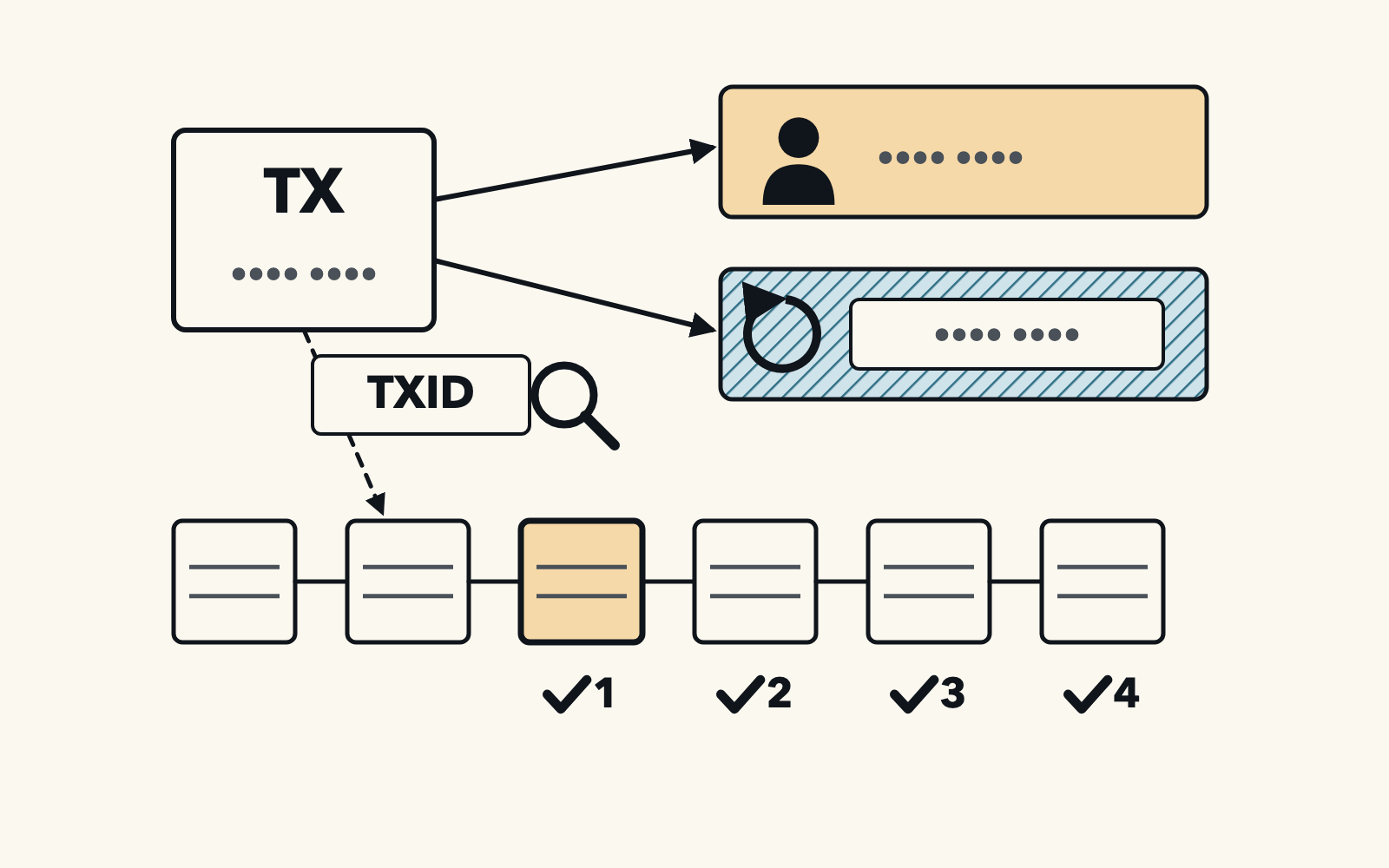
The illustration contains Czech text and has not been localised.
Each item answers a different question
You receive a TXID with a message that the payment has been sent. Does that mean you have been paid? A TXID is a transaction identifier that lets you look up the transaction's record. On its own, however, it neither determines where the payment went nor proves that the recipient received it. The address determines the destination, and the number of confirmations tells you whether the transaction has been included in the blockchain. To check a payment you need all of these; none replaces the others.
In the transaction detail of your wallet or service, check the TXID, the number of confirmations, the address and the amount separately. The Bitcoin Core 29.0 documentation keeps them apart in the same way for transactions in your own wallet: the fields txid and confirmations, and address and amount in the details.
What to compare with the payment request
These steps cover on-chain payments. They are transactions sent to the Bitcoin network, and they get their first confirmation when they are included in a block on the blockchain. Lightning payments are checked differently.
First, prepare the original payment details from a verified source. It is not enough to see that “a similar amount went somewhere”. Check that you are following the right on-chain transaction, the output intended for the recipient, and the requested amount. One transaction can have several outputs, including, for example, change returned to the sender.
If you cannot make sense of the detail, the follow-up article on inputs, outputs and change will help. The total of all outputs is not automatically the amount paid to a single recipient. For a deposit to a service, also compare its instructions and the credit status in your own account. Kraken, for example, describes its own statuses for crypto deposits; confirmation on the network is only one of them. A confirmation on the blockchain therefore does not replace checking that the service has credited the correct deposit.
Broadcasting and confirmation are different states
Broadcasting a transaction to the network does not yet mean it has been included in a block. A transaction receives its first confirmation by being included in a block, and each further block that follows raises the count. An unconfirmed payment should therefore not be judged in the same way as a payment with confirmations.
The Bitcoin Core documentation also distinguishes conflicted and replaced transactions. Two transactions that spend the same output cannot both be valid in the same chain. If your wallet reports such a conflict, do not take the old TXID as proof of a completed payment. First clarify the current status using the wallet's documentation and with the recipient. Do not send another payment just because someone's screenshot looks convincing.
Model: the recipient requires three confirmations
For this one illustration only, let us imagine a fictitious recipient who requires 30,000 satoshis and three confirmations. The label MODEL-A is an invalid placeholder, not a real TXID. The amount, the states and the requirement are all invented, and no payment took place.
| Model state of MODEL-A | What follows from it |
|---|---|
| 0 confirmations | The transaction has not yet been confirmed by a block |
| 2 confirmations | The recipient's model requirement is not yet met |
| 3 confirmations | Only the model condition on the number of confirmations is met |
Even the last row will not rescue a wrong address or amount; it always assumes that you are checking the right transaction and the right output. Three confirmations here are neither a universal security standard nor a promise of a particular waiting time. Find out the requirements of the specific recipient before paying. Wider context on waiting can be found in the article on scaling.
You do not need the recovery phrase to verify
You may tell the recipient the TXID when resolving a payment, but consider how much you reveal. The public history can show amounts and related addresses. If you link the identifier with your identity, you may reveal more than you intended. A public post showing transaction details can therefore compromise your privacy.
Never send a recovery phrase (the wallet's backup words), a private key or login details to anyone as “proof of payment”. The verification described here concerns an identifier and the public details of a transaction, not handing over control of a wallet. Treat someone else's screenshot as a prompt for your own check, not as its result.
If the counterparty makes the withdrawal of supposed profit conditional on a further transfer, stop and read the article on crypto scams. For investment fraud, the Czech Police (Policie ČR) describes victims being unable to withdraw their deposits and returns and instead being pushed into further deposits. Do not send another payment on the strength of such an explanation alone.
Sources
- Bitcoin Core 29.0: TXID, confirmations and transaction status in a wallet
- Bitcoin Core 29.0: outputs and amounts in a transaction
- Bitcoin Developer Guide: verifying a payment
- Bitcoin.org: publishing payment details and privacy
- Policie ČR (Czech Police): frauds built on the legend of a profitable investment (in Czech)
- Kraken: the different processing states of a deposit at a service