Buying and strategy
Investing in Bitcoin: technical features and risks
We compare four technical features of Bitcoin with four investment risks highlighted by regulators.
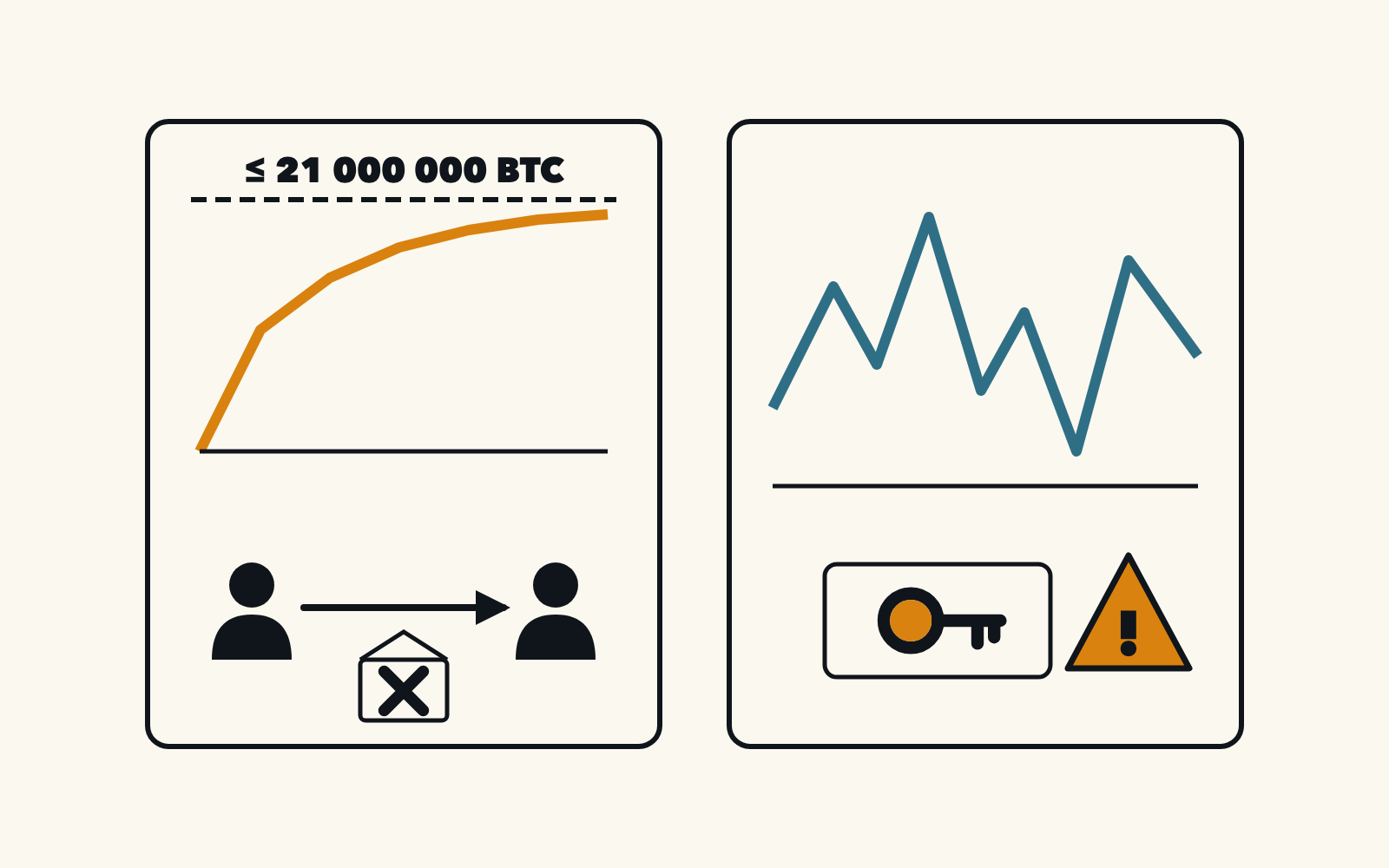
The illustration contains Czech text and has not been localised.
What are you weighing up when you consider investing in Bitcoin? The network rules explain how transfers, issuance and self-custody work. The investment decision also involves the risk of price swings, difficulty selling and losing access. Here's what the technical documentation and regulators say about each point.
Four arguments arising from Bitcoin's design
1. Direct transfers between participants. The original Bitcoin proposal describes how two people can send a payment over the internet. Network nodes and shared rules underpin verification. Buying through an exchange can still involve a service provider.
2. Predictable issuance. The block subsidy started at 50 BTC and halves every 210,000 blocks on the main network. Under these rules, total issuance is capped at roughly 21 million BTC. The calculation is public in Bitcoin Core's code.
3. A public history. The blockchain lets people inspect confirmed transaction records, and a full node checks transactions against the rules. A public history affects privacy. If an address is linked to your identity, others may be able to link further payments to you.
4. Self-custody. If you hold the keys and have everything needed to sign a transaction, you can manage the funds yourself. The developer guide describes signing on a separate device that stays offline. Self-custody makes you responsible for backup and recovery.
Four risks that regulators point out
1. Price swings. The European supervisory authorities (EBA, EIOPA and ESMA) warn that prices of most crypto-assets, including some regulated ones, can rise or fall quickly. You could lose your entire investment.
2. Scope of protection. The European authorities explain that MiCA provides rights such as access to information and complaints handling for certain services. The scope depends on the service and provider. They warn that MiCA protection does not include the compensation schemes available for some traditional products. A provider outside EU regulation may offer weaker protection or none at all.
3. Selling and promotion. A lack of liquidity can make it hard to sell when you want or at the price you expect. The European authorities also warn about aggressive promotion. Influencers on social media may have a financial incentive to advertise. The Czech National Bank advises checking credibility independently.
4. Fraud and loss of access. Scammers use bogus offers, messages and malicious links. If you lose the keys and backups you need to sign, you may lose access to your funds permanently.
What to check before deciding
The European authorities recommend understanding the product and considering whether you could afford the loss. Check that the provider's EU authorisation covers the service and find out in advance how you'll secure custody. For public offers of crypto-assets with a MiCA white paper, the Czech National Bank advises reading the documents, weighing the risks and resisting pressure or promises of high returns. That advice concerns the documents for a public offer under MiCA. The original 2008 Bitcoin paper describes the network design.
Sources (checked 24 October 2026)
- ESMA, EBA, EIOPA: Warning on crypto-assets (6 October 2025)
- Czech National Bank (Česká národní banka): what you should watch out for before investing in crypto-assets (Na co byste si měli dát pozor před investováním do kryptoaktiv)
- Satoshi Nakamoto: Bitcoin: A Peer-to-Peer Electronic Cash System, bitcoin.org
- Bitcoin Core v29.0: GetBlockSubsidy (a reward of 50 bitcoins, halving every 210,000 blocks)
- Bitcoin Developer Guide: Wallets and Block Chain
- ESMA, EBA, EIOPA: Warning on crypto-assets, full text (PDF, 2025; added 29 October 2026)