Buying and strategy
What DCA means and how regular Bitcoin purchases work
DCA means buying for the same amount at regular intervals, regardless of the current price. We explain how it works using hypothetical figures and show what regular purchases cannot address.
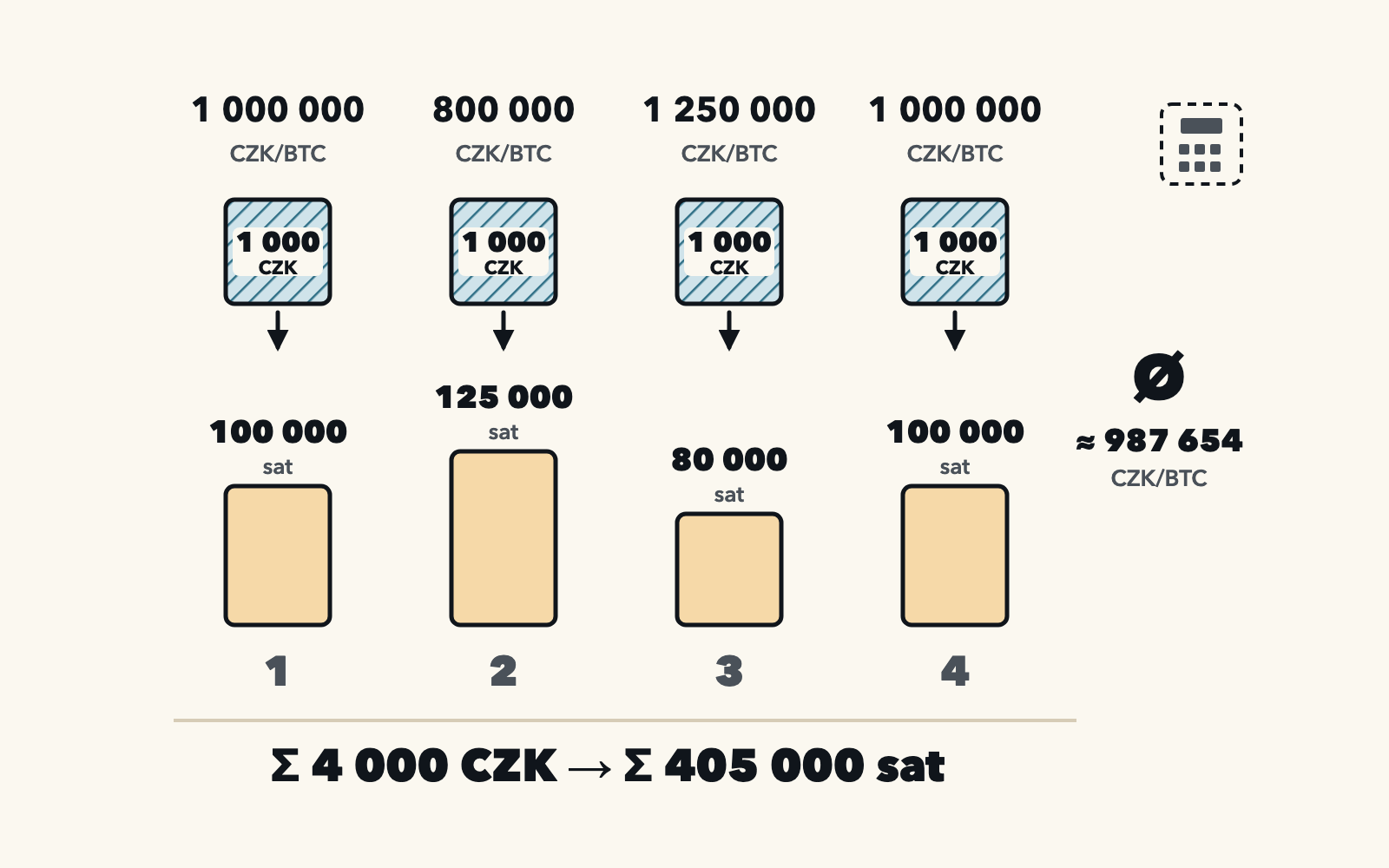
The illustration contains Czech text and has not been localised.
What DCA means
What happens if you spend the same amount on bitcoin each month while its price changes? You get more bitcoin when the price is lower and less when it is higher. The US Securities and Exchange Commission's Investor.gov site calls this dollar-cost averaging (DCA): investing equal amounts at regular intervals regardless of market movements.
For the example, take four monthly purchases of CZK 1,000 each. The exchange rate on the day of each purchase determines how much BTC you get for the same amount.
An illustrative calculation
The table uses hypothetical exchange rates and four payments of CZK 1,000 each. Fees and taxes are excluded.
| Month | Amount invested | Hypothetical rate (CZK per 1 BTC) | Obtained (BTC) |
|---|---|---|---|
| 1 | CZK 1,000 | 1,000,000 | 0.00100 |
| 2 | CZK 1,000 | 800,000 | 0.00125 |
| 3 | CZK 1,000 | 1,250,000 | 0.00080 |
| 4 | CZK 1,000 | 1,000,000 | 0.00100 |
The four purchases cost CZK 4,000 and buy a total of 0.00405 BTC. Divide the amount spent by the bitcoin bought to get an average purchase price of about CZK 987,654 per BTC. The simple average of the four exchange rates is CZK 1,012,500 per BTC. The figures differ because the same amount buys more bitcoin at a lower rate.
At a hypothetical final rate of CZK 1,000,000 per BTC, the bitcoin bought is worth CZK 4,050. At CZK 1,100,000 per BTC it is worth CZK 4,455, and at CZK 950,000 per BTC it is worth CZK 3,847.50. With fees and taxes excluded, the average purchase price is the break-even point. The result depends on the rates when you buy and when you value the holdings. This example illustrates the calculation for one buying pattern.
What DCA does not solve
- The risk of loss remains. The European supervisory authorities (ESMA, EBA and EIOPA) warn that the prices of most crypto-assets are volatile and you could lose the entire amount invested.
- Returns are uncertain. Investor.gov says a regular schedule can help manage risk. The outcome still depends on the market.
- Fees can add up. A provider may charge for every purchase. Use its actual fees when comparing buying patterns.
- Checking the provider and securing your wallet are separate steps. The European supervisory authorities recommend verifying that the provider's EU authorisation covers the specific service and securing your wallet.
What to watch out for
Before deciding, consider how a loss could affect your finances and goals, as the European supervisory authorities advise. The Czech National Bank warns against unrealistic promises of high returns. Even with regular purchases, the investment can fall to zero.
Sources (checked 29 October 2026)
- Investor.gov (U.S. Securities and Exchange Commission): Dollar-Cost Averaging
- ESMA, EBA, EIOPA: Warning on crypto-assets (6 October 2025)
- Czech National Bank (Česká národní banka): what you should watch out for before investing in crypto-assets (Na co byste si měli dát pozor před investováním do kryptoaktiv)