Security
How to store bitcoin safely: your own wallet, a custodian and a backup
Whoever controls the private keys controls the bitcoin. An overview of the choice between your own wallet and a custodian, what a backup of the recovery phrase is for, and why you should never enter it on a website.
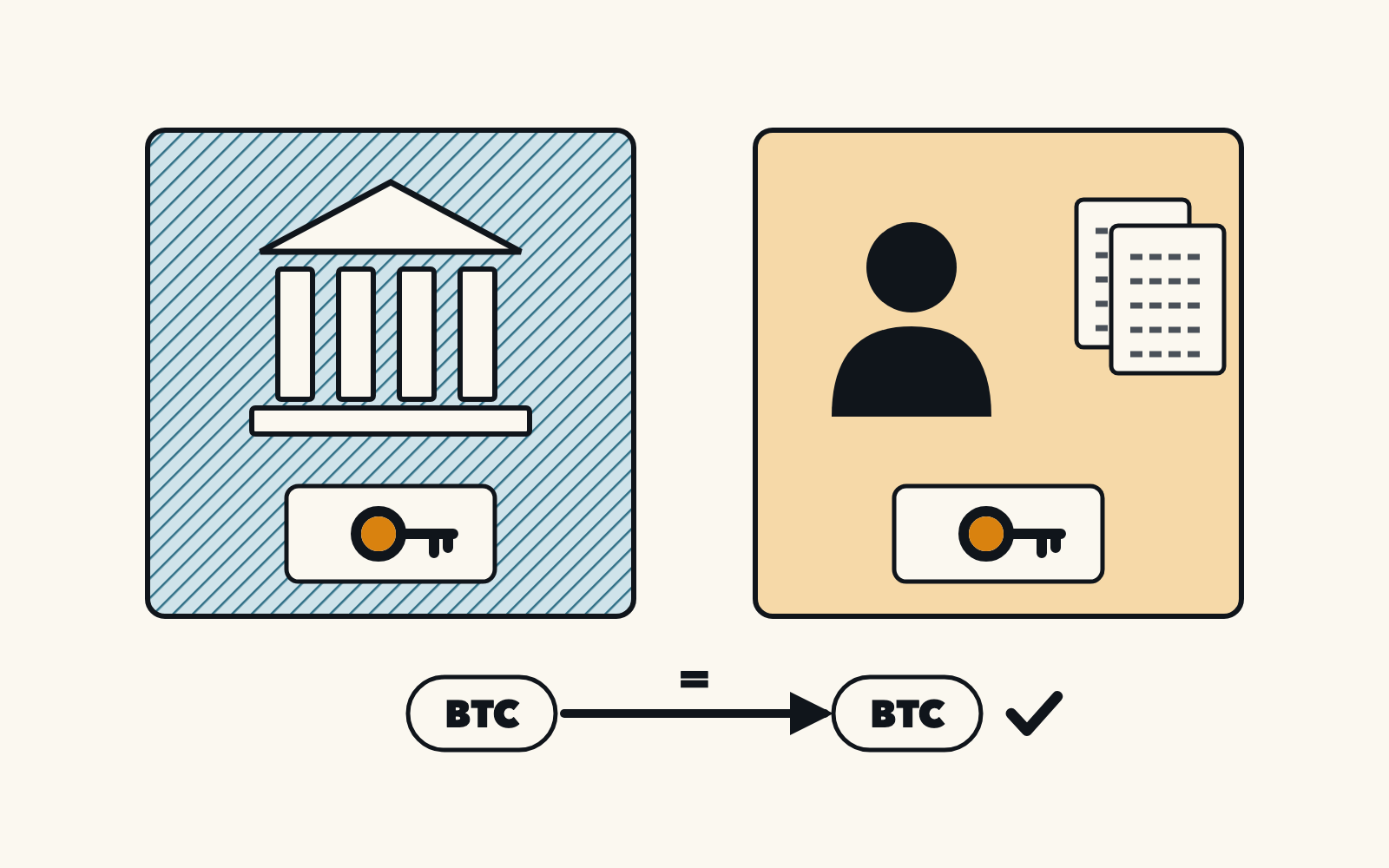
The illustration contains Czech text and has not been localised.
You're setting up your own wallet, and it asks you to write down some backup words. What are they for, and how should you store them? A wallet using BIP 39 can give you a phrase of 12, 15, 18, 21 or 24 words. Other backup formats exist. Start by checking who controls the private keys and how your wallet's documentation says to restore it.
Keys matter more than an “account”
A wallet manages the private keys used to sign transactions. Whoever has everything required to sign under the wallet's setup can spend the bitcoin. The European supervisory authorities (ESMA, EBA and EIOPA) warn that losing access to private keys can mean permanently losing access to the funds. You can replace a lost device if you have a usable backup and the information needed to restore it.
Your own wallet, or a custodian?
- Custodian. You have an account with a provider that manages the keys and secures the service. The supervisory authorities warn that consumer protection may be limited. They recommend checking that the provider's EU authorisation covers the service you plan to use.
- Self-custody. You control the keys yourself and do not depend on a provider's decisions. You are also responsible for backing them up, though: if you lose both the keys and the backup, nobody will usually be able to help. Holding your own keys also does not guarantee that you will always have a working device or a network connection at hand.
With a hardware wallet, you typically sign on a separate device. The connected app prepares the transaction and broadcasts it after signing. Whether a payment needs one device or multiple signatures depends on your wallet's setup.
Backup words, seed and private keys
A hierarchical deterministic (HD) wallet derives its private keys from a single root seed. Under BIP 39, the wallet computes a 512-bit seed from the recovery phrase and any passphrase. Restoring the wallet may also require the original backup format, its settings or further information for a wallet that uses multiple signatures (multisig). Check your wallet's documentation for the recovery procedure.
For an ordinary single-signature wallet with a BIP 39 recovery phrase, this leads to the following rules:
- The recovery phrase and any passphrase may be enough to derive the keys. Protect them as carefully as you protect access to your bitcoin.
- Keep your recovery phrase off websites and never send it to anyone, including someone claiming to be support. If you need to enter it to restore the wallet or check your backup, use your own verified wallet or device and follow its documentation.
- Make the backup in advance. A saved seed can also derive keys created later in the same HD wallet. Older wallets without a common seed required ongoing backups for new keys. Losing a key before it was backed up could mean losing access permanently.
- When choosing where to store the backup, consider whether one fire or burglary could destroy it or leave you without it. The right approach depends on your device and backup method.
A passphrase as an extra
BIP 39 lets you add an optional passphrase to your recovery phrase. A different passphrase produces a different valid seed, so a typo can open a different wallet. If you lose access to your intended wallet and all copies of the correct passphrase, the recovery phrase alone cannot restore it. Store the passphrase securely, separately from the recovery words. Together they can derive the keys.
Basic device security
The European supervisory authorities recommend keeping devices and crypto-related software up to date, using a strong, unique password for each account, not reusing the same credentials across platforms, and not logging in over public or unsecured Wi-Fi. Encrypting the wallet file protects the keys while they are not in use. According to the documentation, however, it does not protect against an attack that captures the encryption key or reads the decrypted keys from memory.
Before sending a payment
According to the documentation, a signing device often lets you review the details of a transaction, especially its outputs, before you sign. Do not skip this step: compare the full destination address and the amount on the device. The device only shows what is being signed, though. Whether the address belongs to the right recipient, and whether the recipient expects a payment on the Bitcoin network, has to be checked against the original source, ideally with the recipient directly.