Security
Is Bitcoin anonymous? What a public blockchain reveals about you
Bitcoin is often called anonymous. It is more accurate to say that transactions are public and addresses carry no name. How easily an address is linked to a particular person depends on how you handle it.
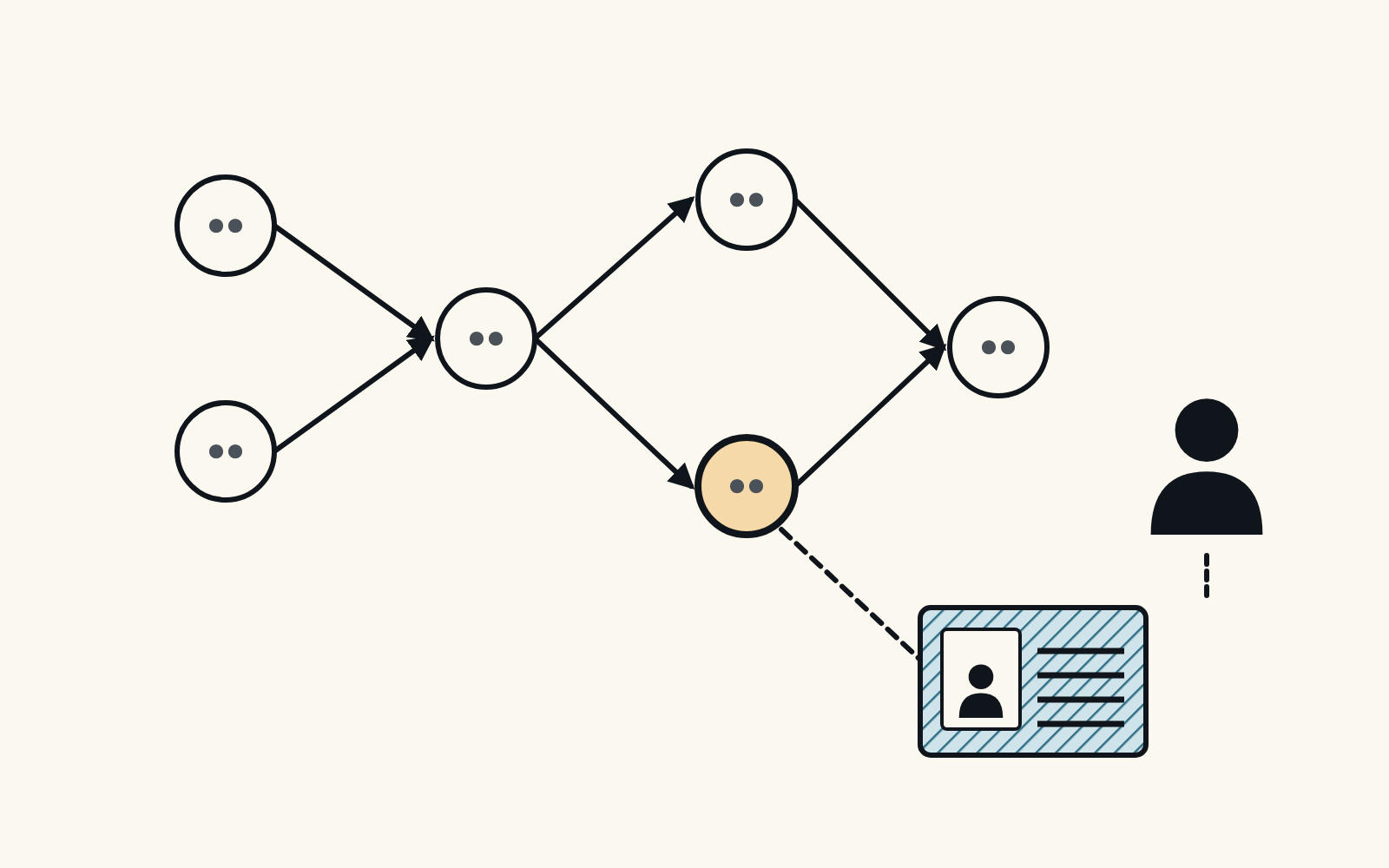
The illustration contains Czech text and has not been localised.
Public transactions, addresses without a name
You send a payment over the main Bitcoin network. What can others learn once the transaction is included in a block? The public record shows its inputs, outputs and amounts. Linking those details to a person's name takes additional information. Publicly broadcasting transactions is part of the original 2008 Bitcoin design.
The original design compares Bitcoin's public data with stock exchange records. The time and size of trades are public, while the parties' names are absent from the record. Bitcoin addresses therefore act as pseudonyms.
Where a pseudonym gives itself away
Once a public address is linked to your identity, the same trail may reveal other transactions. The original design recommends a fresh key pair for each payment to reduce the risk of linking them.
Some linking cannot be avoided altogether. The original design notes that transactions with several inputs reveal that the inputs belonged to the same owner. Today this is treated as a guide, not a certainty: BIP 78 describes it as a heuristic that holds for most transactions but not all. Analysts often rely on it, but it can be misled by payjoin, for example, a transaction to which both the sender and the recipient contribute inputs. Bitcoin's developer documentation adds a practical warning: reusing the same public key or address makes it easy for others to track your incoming and outgoing payments. It therefore advises against address reuse and recommends sending change to a new address rather than back to an old one.
What this means in practice
- An address is not hidden. Anyone who knows it can view its entire history. If you publish an address together with your name, for example for a fundraiser or on a social media profile, you link yourself to everything associated with that address.
- Do not keep using the same address. Have a new address generated for each payment; your wallet's documentation explains how it handles this. A new address does not by itself guarantee anonymity, though.
- A provider may know your identity. If a service verifies your identity when you buy, it can link the purchase to your personal data. For the Czech context, the Financial Analytical Office (FAÚ) describes, in its position paper “Identifikace klienta” (Client identification) of 5 November 2025, the obligation to identify clients under Section 7 of the Czech AML Act and the various ways of doing so; the procedure depends on risk, the type of obliged entity and other circumstances. This does not mean that every bitcoin transaction requires identity verification. What data a particular service collects is set out in its terms and its privacy information.
- Privacy is not a guarantee. None of the above means that payments can be reliably “hidden”. We do not recommend any methods for concealing the origin of money.
Why it matters
The public blockchain lets you look up older confirmed transactions too. You can see their outputs and amounts. Identifying the actual recipient requires more information. Before sharing an address publicly, consider which parts of your payment history others might link to you.
Sources (checked 24 October 2026)
- Satoshi Nakamoto: Bitcoin: A Peer-to-Peer Electronic Cash System, bitcoin.org, ch. 2, 3 and 10 (the 2008 design)
- BIP 78 (Payjoin), the Motivation section (the common-input-ownership heuristic)
- Bitcoin Developer Guide: Transactions (the sections “Avoiding Key Reuse” and “Transaction Fees And Change”)
- Financial Analytical Office (Finanční analytický úřad): the position paper “Identifikace klienta” (Client identification) (5 November 2025)