Technology
Full node and miner: who verifies what in Bitcoin
A miner searches for a new block, a full node checks its validity. These roles may meet in one operator, but each answers a different question.
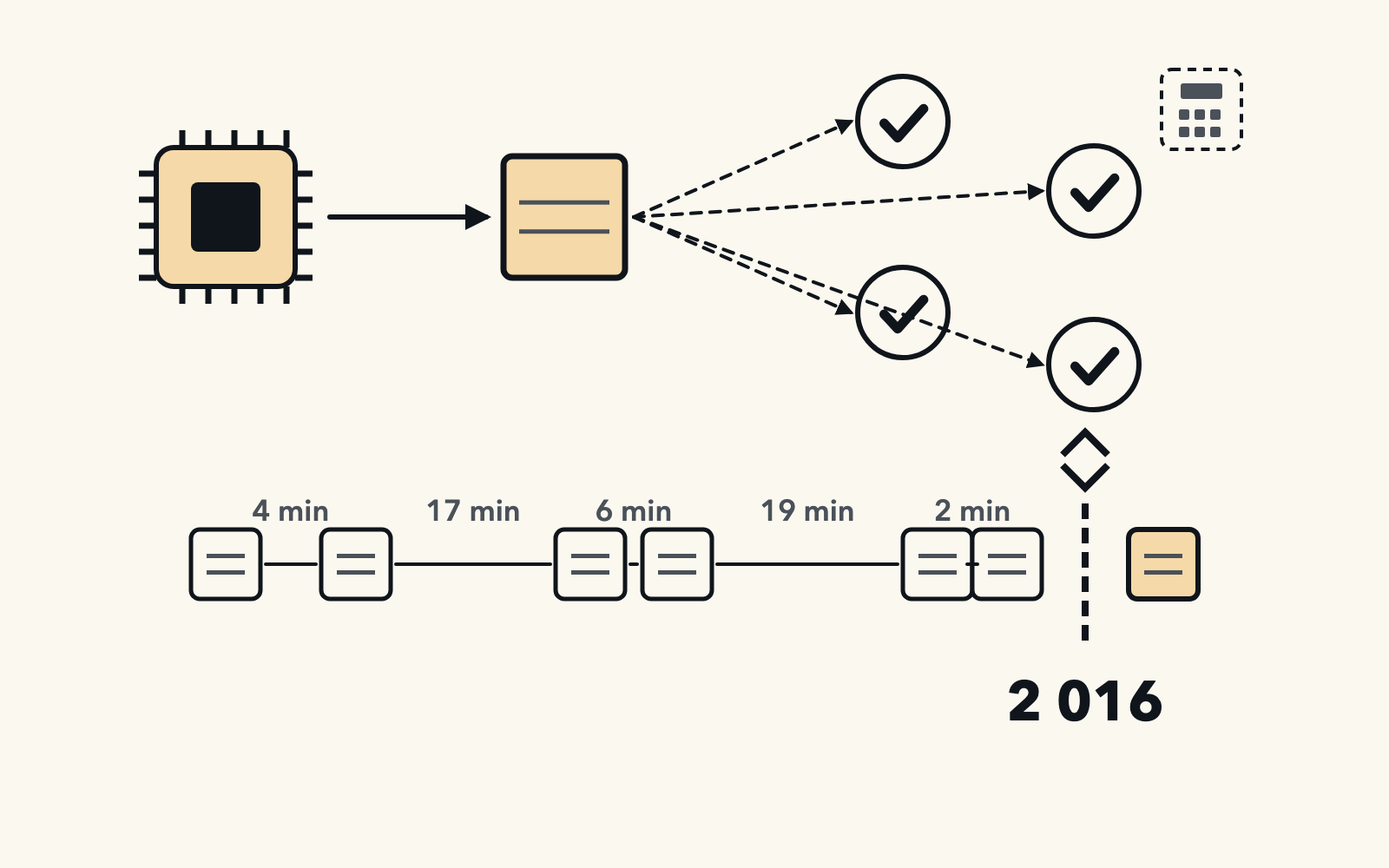
The illustration contains Czech text and has not been localised.
Who actually verifies Bitcoin transactions? The common answer, “miners”, leaves out an essential part of the system. Miners prepare new blocks and search for proof-of-work for them, that is, a result of repeated calculations that is easy to check. Full nodes then check this result independently. The distinction shows why a block that has been found need not yet be acceptable to a particular node.
A full node checks the rules
According to Bitcoin.org, a full node is a program that fully validates transactions and blocks. Each full node therefore checks them itself, against the rules it uses, rather than relying on a report that someone else has already accepted a block. It can also relay valid data to other nodes.
Take a block with a transaction that tries to spend an already spent output again. A fully verifying node will accept neither that transaction nor the block containing it. In the same way it checks whether a miner has not claimed more than the block subsidy (the new bitcoins issued per block) and fees allow. The check of the reward amount can be found in the ConnectBlock function in the Bitcoin Core 29.0 reference code.
Each full node checks a block against its own rules. The number of connections does not change those rules.
A miner searches for proof-of-work
Mining adds new blocks to the chain. A miner prepares a candidate block and, through repeated calculations, looks for a hash of its header that does not exceed the required numerical limit (the target). The result found can then be verified without a node having to repeat all the earlier unsuccessful attempts. Preparing a block and the search are described in the developer documentation on mining.
A full node does not have to take part in this competition. Checking a finished result and searching for a new one are different activities, even though a miner also uses a node or the infrastructure of a pool (a group of miners) in their work.
| Role | Main task | What does not follow from it by itself |
|---|---|---|
| Full node | Independently verify blocks and transactions | A claim to the mining reward |
| Miner | Search for a valid new block with proof-of-work | Acceptance of an invalid block by other nodes |
Even a strong miner has no exemption from checking
Proof-of-work does not entitle anyone to bypass the other rules. If a candidate block contained a reward that is not allowed, a node using the corresponding rules would reject it, even with an otherwise valid proof-of-work. In the code these are separate checks, not a single “mined” stamp.
The network may for a time know several competing branches. Among valid candidates, accumulated work decides; an invalid branch does not become valid merely by being long. The difference between the rules of validity and the choice of history is discussed in the blockchain documentation.
Mining power does matter: it influences the creation and order of blocks and the possibility of reorganising recent history. It does not, however, give a right to spend someone else's output without meeting its conditions.
What your own node brings to a reader
With your own fully validating node you can check the blockchain yourself. A light (SPV) client with the matching proof can verify that a transaction is in a particular block. It does not, however, verify that the block and its transactions are valid. The differences are described in the overview of operating modes.
Running a node costs money for hardware, bandwidth and maintenance. Running a node does not by itself back up your keys, guarantee anonymity or generate income.
How to read a particular transaction is explained in the follow-up article on inputs and outputs. The difference between a block that has been found and the certainty that a payment has been accepted is developed further in the article on the TXID and confirmations.