Your first Bitcoin purchase: from choosing a service to checking the result
Before your first purchase, be clear about what you are buying, how much you will pay in total and how you will get the bitcoin into your own wallet. The guide leads you through the individual decisions without recommending a particular exchange; specific services serve only as examples from their documentation.
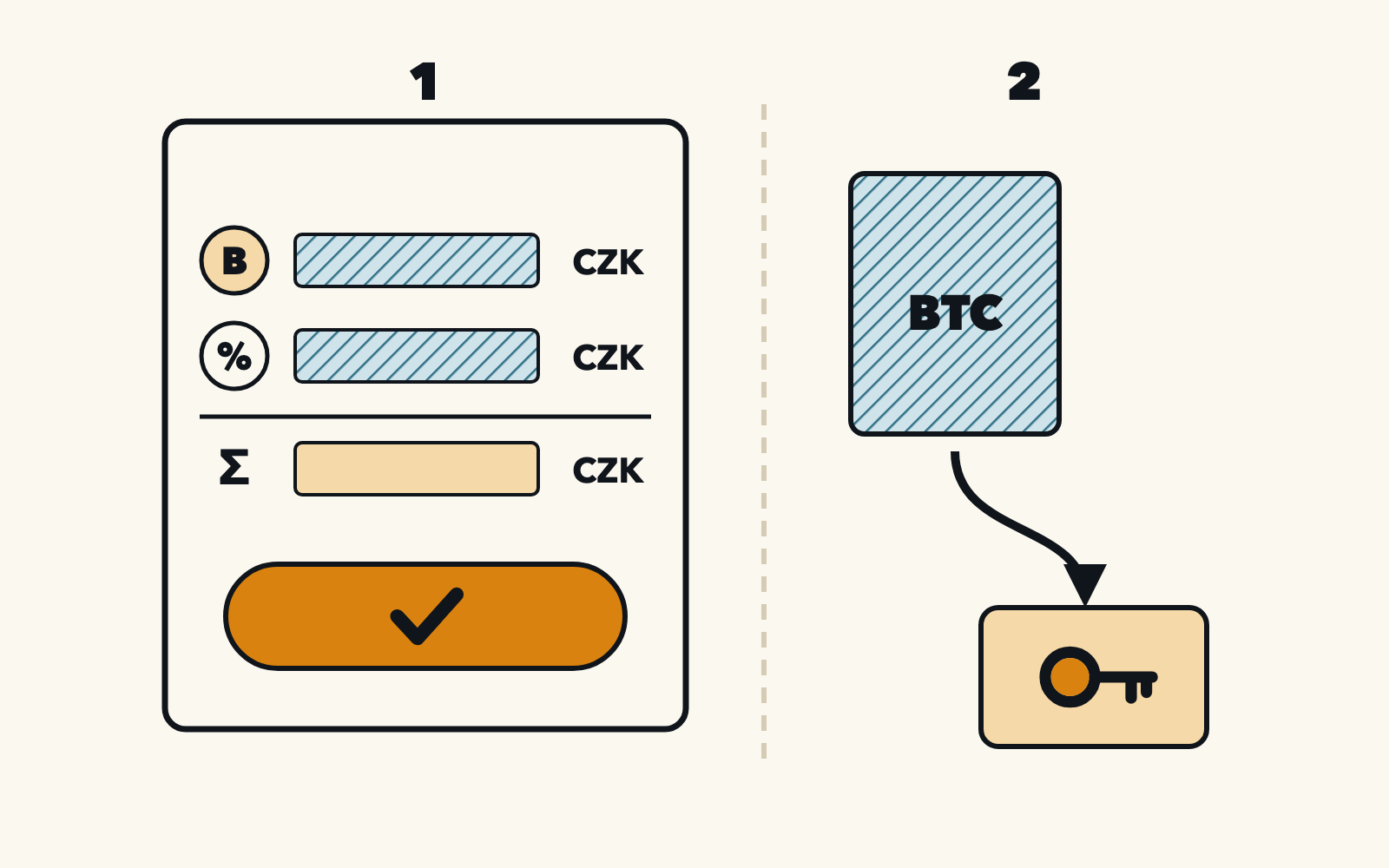
The illustration contains Czech text and has not been localised.
Buying bitcoin for the first time and planning to move it to your own wallet? Before you deposit any money, check what the service will credit to your account and whether you can withdraw BTC over the Bitcoin network. This guide covers a one-off purchase with your own money and an optional withdrawal. The figures in the example are illustrative.
1. Decide whether to buy at all right now
Write down why you are buying and an upper limit for your total spending, including costs. If you only want to understand the process, the model is enough; you do not need to send money just to learn. Bitcoin can lose a lot of value, and a small first purchase does not remove that risk. The European supervisory authorities (in Czech) warn that you could lose a significant part of the money invested, or even all of it.
How to spread repeated purchases over time is explained in the article on DCA. Here we follow a single order and its result.
2. Check the service and the option to withdraw before you deposit
Find the operator's legal name and check that it is authorised for the specific service you plan to use. Use ESMA's register for the EU or the Czech National Bank's registers in Czechia, and compare the entry with the details on the service's website. Authorisation does not guarantee a return. The Czech National Bank warns against unrealistic promises of high returns.
Look for answers to the following questions in the service's terms and help pages. If any answer is missing, clarify it with official support first:
- Are you buying BTC with the option to withdraw to your own wallet? An offer of a derivative or of mere price tracking does not meet the aim of this procedure.
- Are the service and the intended payment method available for your country and account? What identity verification does it require?
- What are the minimum purchase, the minimum withdrawal and the fee for a withdrawal over the Bitcoin network?
- Can the chosen method of payment temporarily restrict withdrawal? Where do you find out its availability?
Conditions differ between exchanges. Kraken, for example, lists withdrawal minimums and fees for each crypto-asset, and its help page on instant buys explains that it may temporarily hold withdrawals after some purchases. This does not mean the same holding period or fees apply at another service.
3. Choose where the bitcoin will be after the purchase
An account with a custodian and your own wallet divide responsibility differently. With a custodian you rely on a third party; with your own wallet you have to take care of the keys and recovery yourself. Finish setting up your wallet according to its documentation before the planned withdrawal. If you do not understand the backup, do not rush the transfer. How to secure and back up a wallet is described by Bitcoin.org.
You will find more detail in the guide to storing bitcoin safely. You do not need your own wallet just to read an offer, but you do need a plan for what comes next before you buy.
4. Prepare the account and the payment
Open the service only through a website or app you have verified in advance. We recommend a unique password and turning on multi-factor authentication if the service offers it. Provide documents only through its verified procedure. The recovery phrase of your own wallet never belongs in a registration form.
For the payment, copy the required currency, recipient and any payment reference from the service's current instructions; do not guess missing details. Find out what currency conversion or the payment method will cost you and where the service will show that your deposit has arrived. If money has left your account and no balance appears, resolve the original deposit through the help pages rather than automatically paying again.
5. Read the offer before confirming
Check the asset (BTC), the direction (buy), the payment currency, the amount, the payment method and whether this is a recurring purchase. Make sure you know whether the amount is your total spending or the purchase before the fee is added. A simple note helps:
| Check | What to note down |
|---|---|
| Total outlay | How much leaves in the payment currency, including the costs stated |
| Result | How much BTC is to be credited after the trade |
| Costs | The explicit fee and any other items according to the offer |
| Withdrawal | The minimum, the fee and the availability of the planned withdrawal |
The quoted price may differ from the chart. If a market order executes, the price depends on the offers available at the time and can differ from the last traded price. A limit buy sets the highest price you will accept. It can fill in part or remain unfilled. Check how your service handles each order type. Kraken's guide to market and limit orders is one example.
This procedure concerns buying BTC without leverage. If the form offers a loan, margin or a derivative, go back to choosing the product. Do not confirm an unclear offer just because a countdown is running.
6. Model: compare the outlay and the BTC credited
Suppose a total budget of CZK 2,000. A fictitious service deducts CZK 20 as a purchase fee, leaving CZK 1,980 for the exchange. The model rate is CZK 2,000,000 per BTC, and there are no other costs in the model.
For CZK 1,980 you get 1,980 / 2,000,000 = 0.00099 BTC. Dividing your total spending by the amount received gives 2,000 / 0.00099, or roughly CZK 2,020,202 per BTC. This is higher than the model rate because it includes the fee. It is not a current market price or a forecast, and it does not yet include the cost of any later withdrawal.
This ratio helps you compare offers with the same scope of costs, but it does not show which item the difference comes from. Check an offer without a separate fee in the same way: compare total spending with the amount credited.
7. After the purchase, check the history and the next step
Confirming the form is no reason to place another order. First check in the history whether the trade has been completed, is pending or was rejected. If it was only partly filled, compare the amount actually credited and the remaining order with the service's documentation. If you are unsure, clarify the status of the original order.
For your own records, keep the date, the service, the currency, your total spending, the BTC received, the fees and the trade confirmation. This helps you trace what you did; it is not a complete tax guide. Do not share access details or identity documents publicly.
If you want to move your bitcoin into self-custody, continue with the guide to withdrawing from an exchange to your wallet. Before you do, check how much BTC is actually available for withdrawal and where it should arrive.